
And we’re back in the heart of the Balkans – starting in Belgrade, capital of Serbia, a country that is still dragging the legacy of Balkan bad boy (from onset of WWI to accusations of ethnic cleansing in the Croatian, Bosnian and Kosovo wars that ended the 20th century.) Serbia is today one of the few countries in Europe that is neither in the EU nor in NATO, and you can almost feel the resentment.
Belgrade: We arrive on a beautiful spring day to find strolling families and musicians in the pedestrianized streets, and settle into the elegant Square Nine Hotel next to the University. First impressions: shabby-chic Art Deco buildings with endless graffiti and great bones; bookstores with cozy seating serving coffee and wine; young, bearded, cassocked priests on the streets with their long hair done up in buns; brides and their entourage of photographers. And some of the tallest people I’ve ever seen – Serbs are out to conquer basketball.
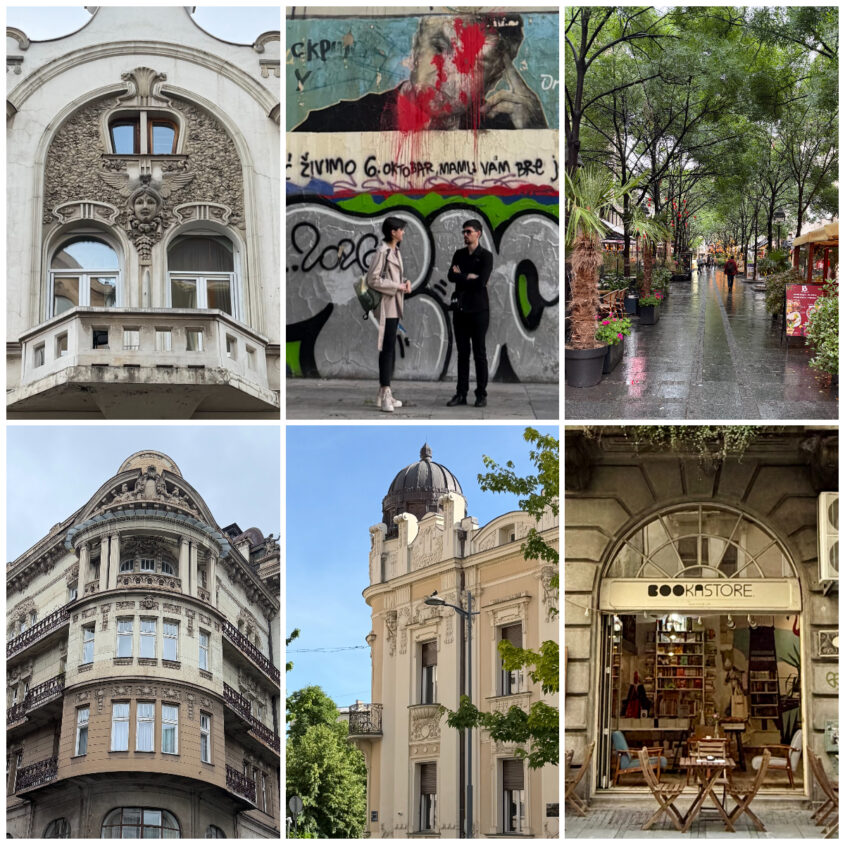
Scenes of Belgrade: Art Nouveau facades, many bookstores, leafy terrace restaurants
We are continuing our Sephardic and Jewish heritage itinerary (See Balkans I – Northern Greece, Bulgaria) and about to confront the tragedy of Jewish communities in Eastern Europe in WWII. We start out with an introduction to the history of the Jewish community – currently on life support, carrying trauma from Fascism, Nazis, Ustase (Croat Nazis) and communism and the break-up of Yugoslavia. Our first stop is the Holocaust memorial on the Danube in the shadow of the former Jewish quarter, followed by a visit to the new memorial museum of “The Old Fairground” concentration camp (the actual name) from which 90% of Serbia’s 17,000 Jews in 1941 were either sent to labor camps or murdered in truly awful ways.

Top: a map of the “Old Fairground” – literally a summer fairground turned into a holding camp for Jews awaiting “deportation” – effectively death by asphixiation in sealed trucks turned into mobile gas chambers. Bottom: Propaganda in the museum. (Puppet masters; same old story). Bottom right: the bucolic looking site today of the Old Fairground: a Turkish restaurant is located on the site of the former morgue. Evidently it’s quite popular. The history isn’t advertised, but it’s known.
The Jewish population today is nominally 1,500 – many intermarried; many “mixed” Jewish marriages between the various ethnicities of the former Yugoslavia – Bosnian, Slovenian, Hungarian, Serbian – Ashkenazi, Sephardi. (I have the sense that this “mixing” is unwelcome and you can’t help but despair at the on-going ethnic suspicion.) The one functioning synagogue in all of Serbia – Sukhat Shalom – is Ashkenazi in style (dedicated in 1924; restored in 2002) but also serves the very small Sephardi community.

Sukhat Shalom interior and the exterior of the Jewish Community Center.

Top L: Holocaust memorial on the banks of the Danube. Bottom and left: Inside the atmospheric Sephardic cemetery; still in use, roses in bloom.
After two beautiful days the skies open and spring rains threaten to drench. We hit the national museum (beautiful neoclassical building) with archeological finds dating back to the Thracians, contemporary Serbian paintings, some beautiful icons, and and very few visitors.
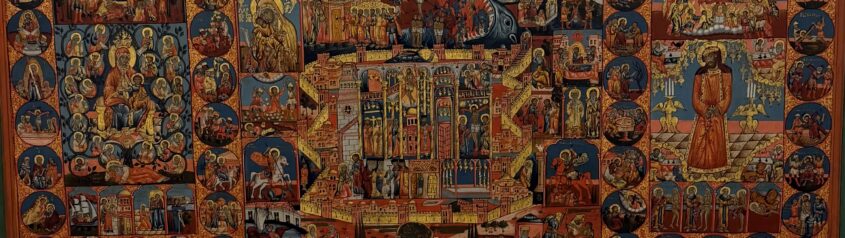
Wood panel with painted religious scenes from 1300s in National Museum
Dodging raindrops we head to the huge Saint Sava cathedral – the seat of Serbian Orthodoxy – dedicated to the patron saint of the country, a symbol of resistance to the Ottomans and, in modern times, a flag-bearer of the intertwining of Serb nationalism and the Serbian Orthodox church. A delegation arrives with relics from various monasteries dedicated to Saint Sava which is front page news: members of parliament meet the delegation at the airport with great fanfare. Unlike in Western Europe; religion here is alive and well. And with heavy overtones.
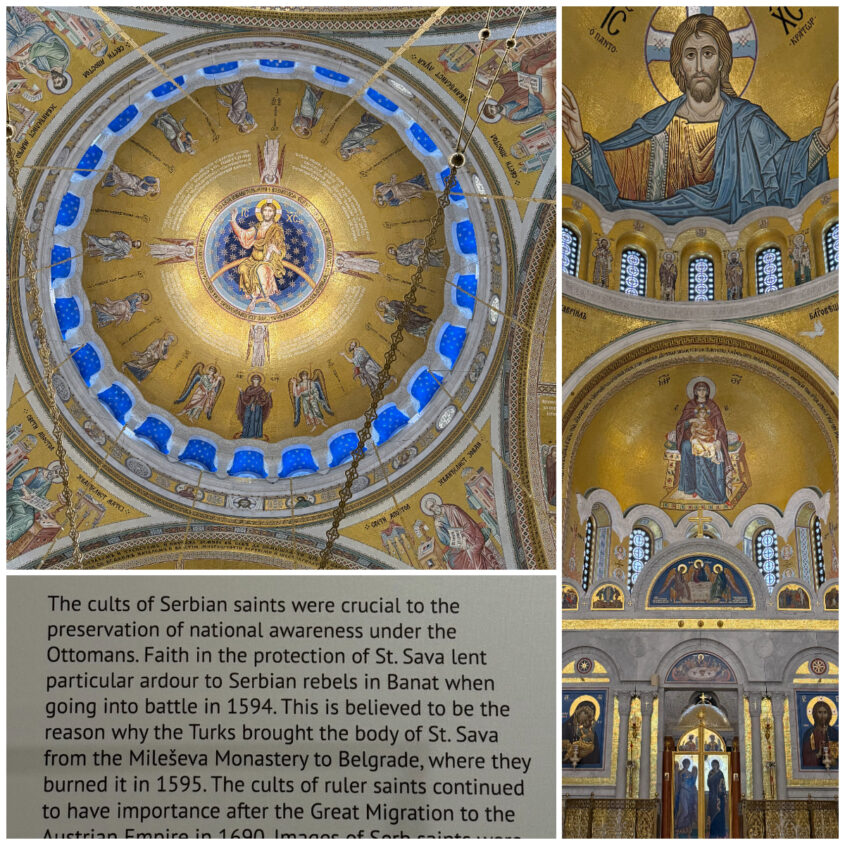
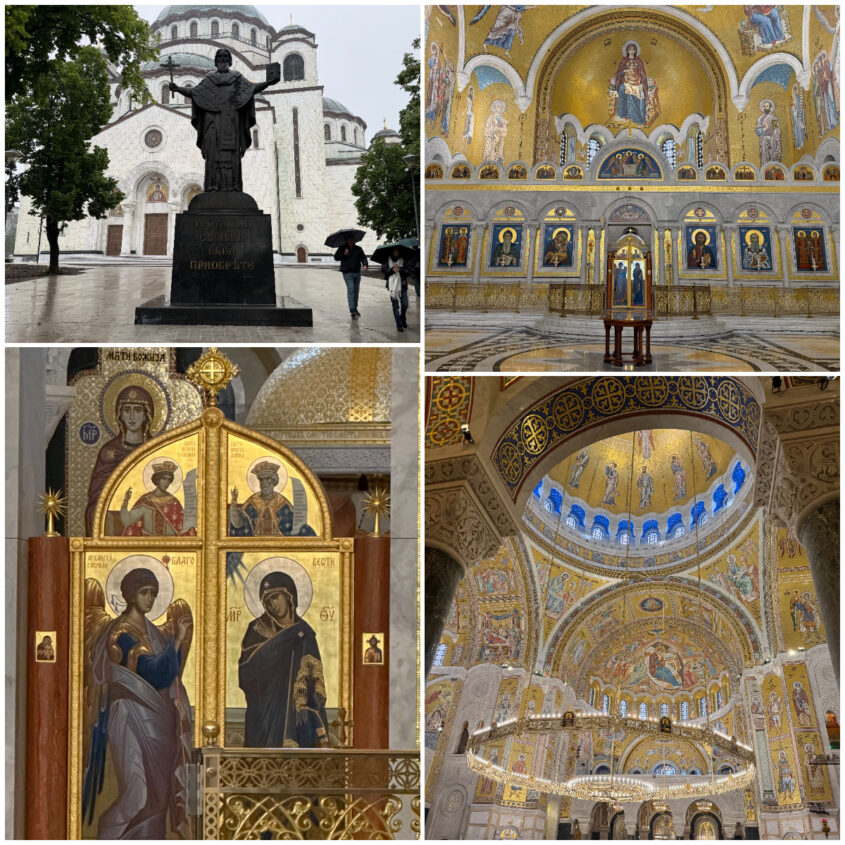
The cathedral – largest in the Balkans – was built on the site where the Ottomans burned the saint’s bones in 1592. (Not forgotten.) It is a place of pilgrimage wrapped in gold, with eye-popping mosaics lining the walls and huge ceiling domes. People approach, kneel and commune with the beautiful icons propped throughout the floor (there are no seats in orthodox churches; people stand during services). But this cathedral misses the intimacy and soul of most orthodox churches, which tend to be tiny and candlelit. Instead, here (as in the Vatican or any corporate headquarters) you should feel small and know who’s in charge.
A landlocked country of only 6 million with a strong Orthodox identity, Serbia still dwells on the Ottoman victory of 1389 on the “sacred fields” of Kosovo – also the site of Serbia’s founding monasteries and hallowed churches which today are still located in the disputed state of Kosovo. (Serbian Orthodoxy considers itself the true heir to the original Christianity – passed on directly from the apostles in an unbroken chain.) My observation: religious and ethnic identity mixed with blood-and-soil nationalism can be a nasty combination – as anyone who witnessed the break-up of Yugoslavia can attest. The “fields of Kosovo” in the bloody civil strife of 1999 – six hundred years after the original Ottoman defeat and humiliation – are a stark reminder.
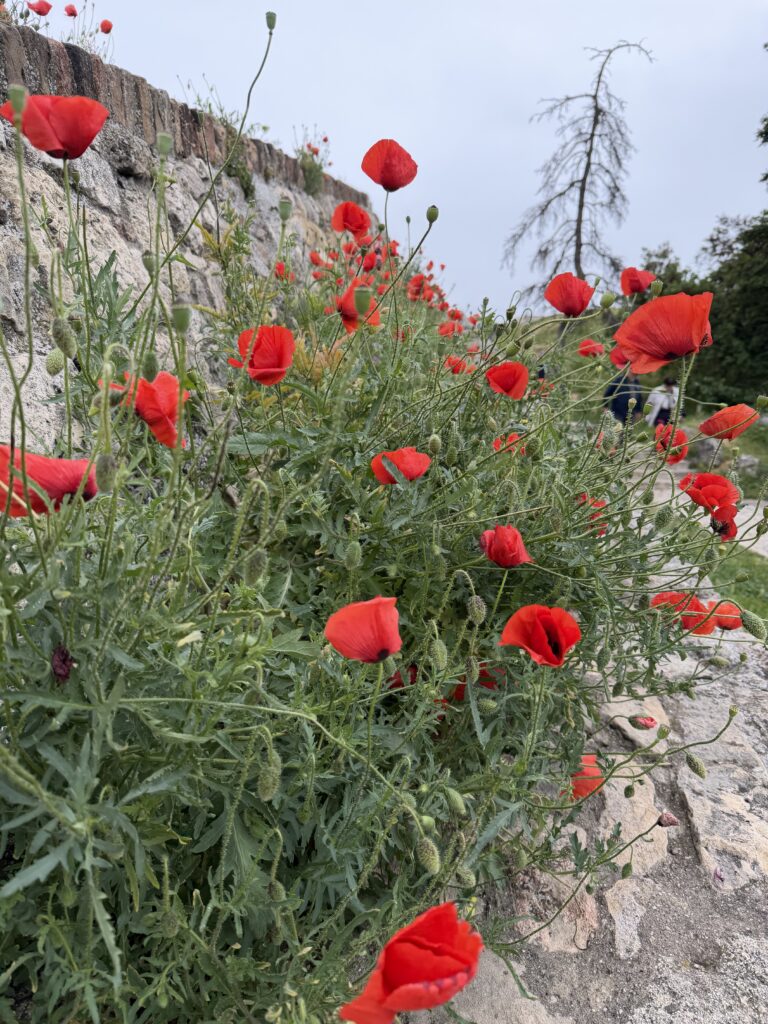
Kalemegdan Fortress and Park is around the corner from our hotel and the pedestrianized city center. A former fortress built in antiquity and fought over by the Austrians and Ottomans for centuries. (The name comes from the Turkish kale (fortress) meydan (field). Now a huge park, it overlooks the meeting of the Sava and Danube rivers. Destroyed dozens of times, it’s rebuilt with castle walls, turrets, tunnels, gates and with views down to the surprisingly untouched Danube (no shoreline developments) as it lazily moves out of the flatlands and on to Romania and Bulgaria. We go for a long meander through the park, green, well preserved, school groups, kids hanging out, very few foreign tourists. And poppies – lots of bright red poppies everywhere.
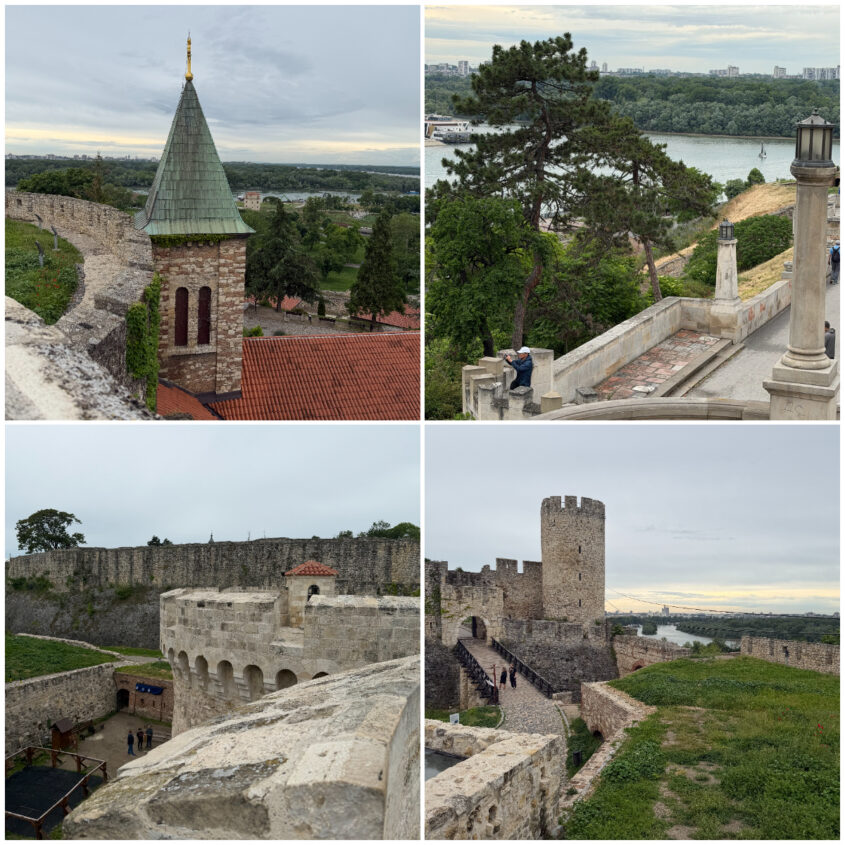
Kalemegdan Fortress in the rain overlooking the confluence of the Saba and Danube rivers.
In the rain, the city is atmospherically shabby – and no wonder – after major wars, decades of communism, depopulation from emigration and without the benefit of EU funds. But look carefully and it is full of Belle Epoque architecture begging to be restored, sadly much of it afflicted with pervasive graffiti (a theme throughout our travels). On the side streets, under the blooming linden trees there are pop-up restaurants, DJs playing from the open windows, and a lively food scene.
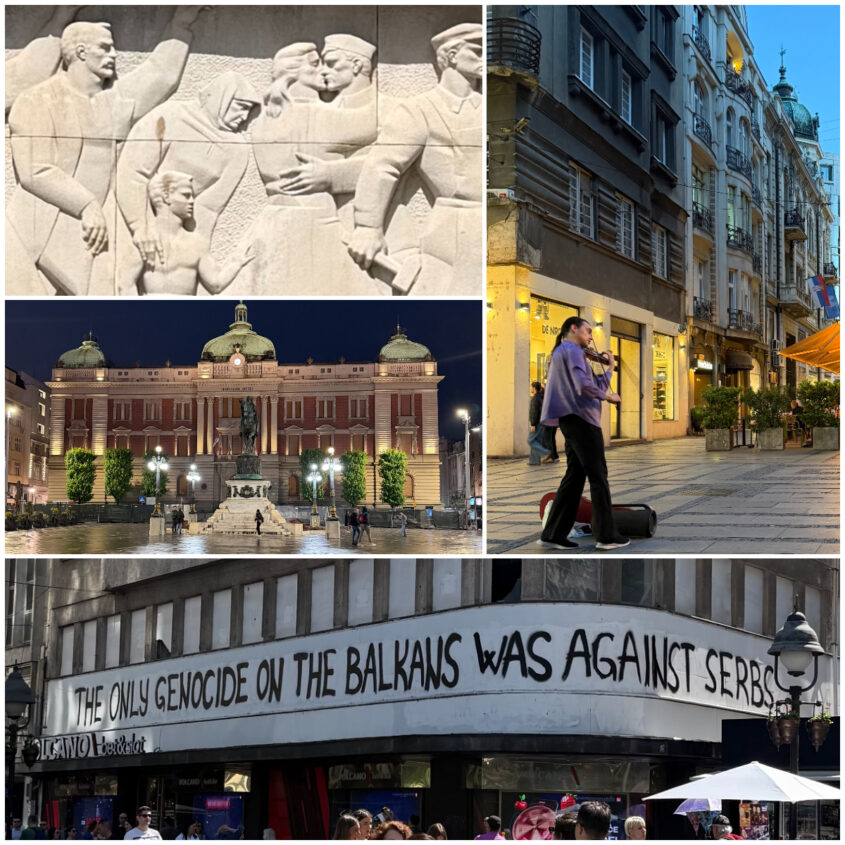
Top L to R: The Red Army arrives in 1945. A violinist on the streets at sunset. The National Museum. The banner speaks for itself.
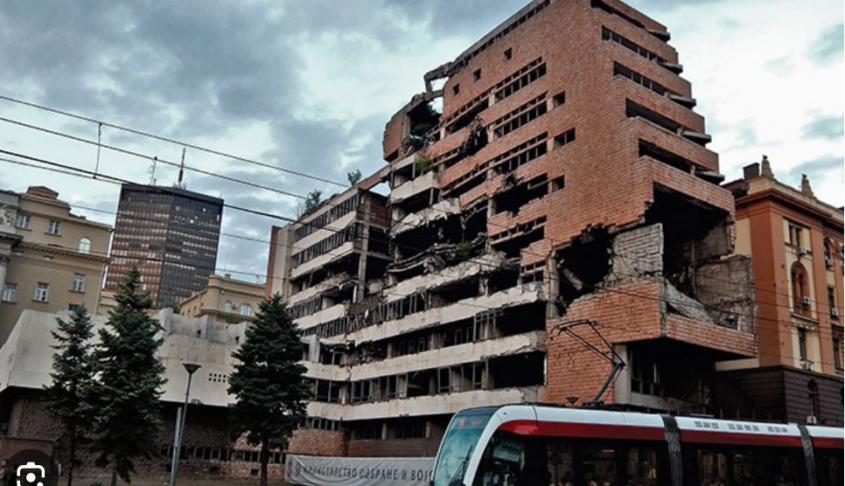
A banner draped around a University building declares that the only genocide was against the Serbs. (Which genocide? WWII? The 1990s? The 1500s?) It sums up the attitude of a small country frozen out of the rest of the continent. It is worth noting that the damage from NATO bombing of the Interior Ministry in spring 1999 during the battle of Kosovo is still standing, (below) with its innards spilling out and looking very dangerous. Various plans for reconstruction (or memorial?) are in play – including (gotta love this) a proposal for a Trump-Kushner luxury hotel. Protests ensued – stay tuned.
After four days we leave Belgrade and head north to the area known as Vojvodina – part of Hungary until 1918 (and again during WWII) and still an autonomous province where students can attend school entirely in Hungarian. (I question the logic of a minority group in a tiny country not learning the majority Serbian language – but then I come from Quebec where logic does not prevail). The University of Novi Sad – Serbia’s second largest city, offers programs taught entirely in Hungarian.
This is the breadbasket of the country, also with mining, petroleum and an IT industry – and a battleground between empires for centuries. These flat plains between Ottoman and Austrian empires were fought over repeatedly with populations that shifted accordingly – Serbs, Hungarians, Germans, Austrians. We pass through the pleasant weekend vacation town of Sremsky Karlovcy – which could be anywhere in Austria with its many cafes and shops offering wine and honey (for which the region is famous), and head on to Novy Sad and the Petrovaradin Fortress overlooking the Danube – last hold-out against the Ottomans. (Have I mentioned that these guys are always in the rear view mirror?)
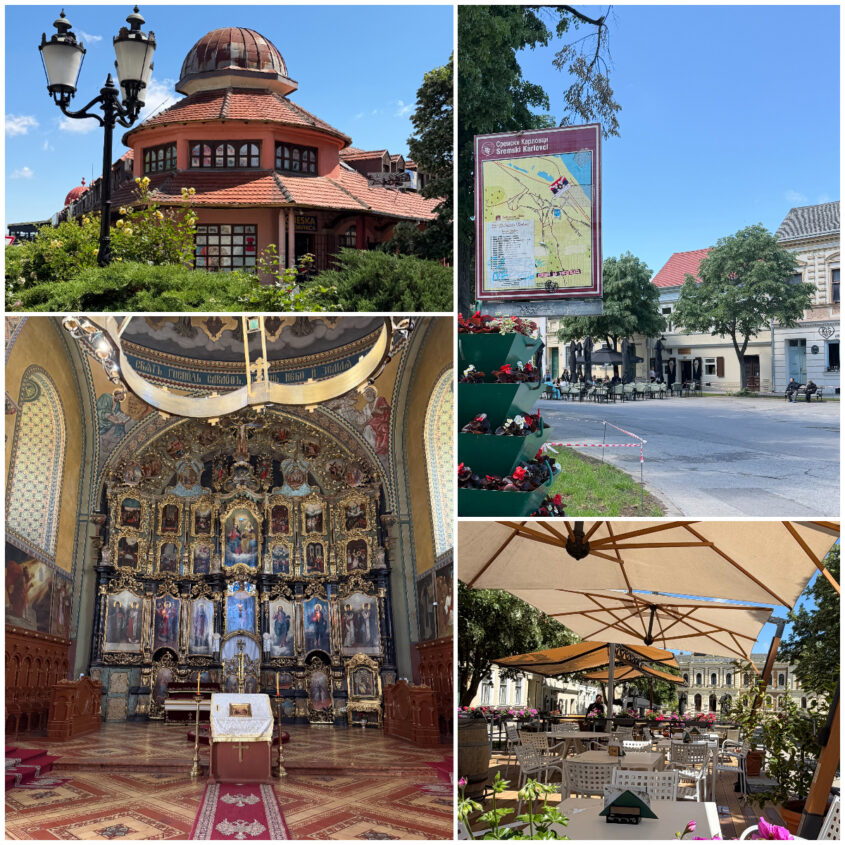
Scenes from “this could be Austria” Sremsky Karlovcy
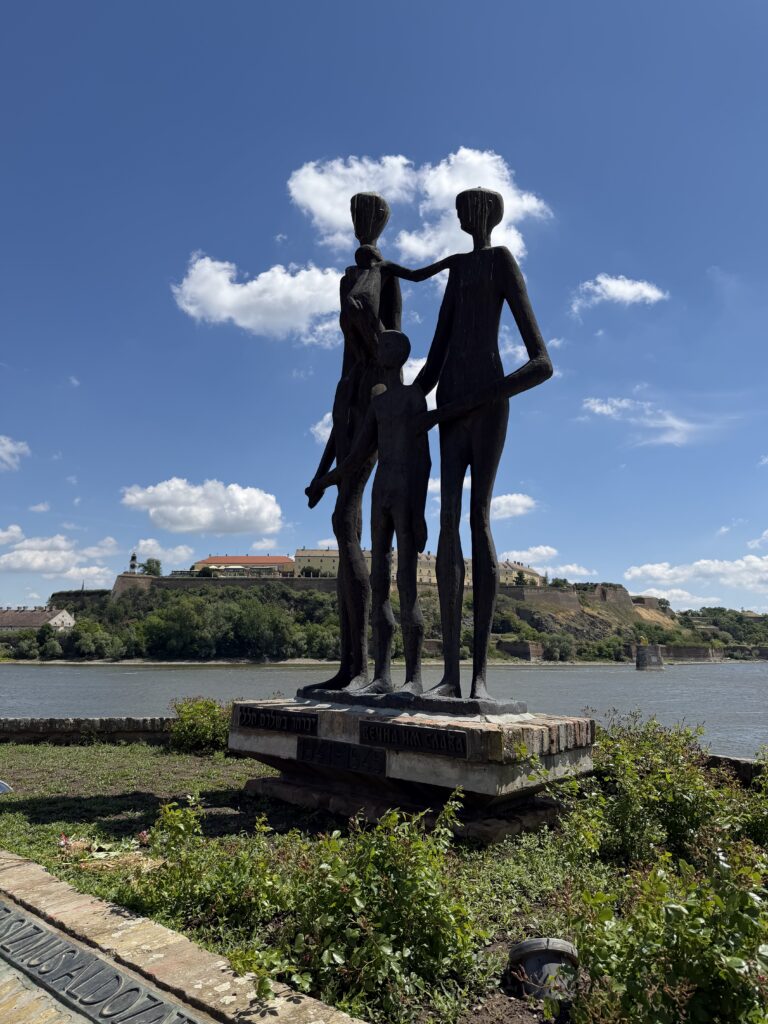
Novy Sad – Serbia’s second largest city spreads along on the Danube; some river cruise boats docked alongside. A stroll through the central pedestrian area reveals a pleasant city with the architecture of anywhere in the Hapsburg empire. Along the banks of the Danube we stop at the Holocaust memorial (below, with Petrovaradin Fortress in background); Serbia was occupied by Nazi Germany in the winter/spring of 1941, with round-ups and murders of Jews and Roma following immediately.
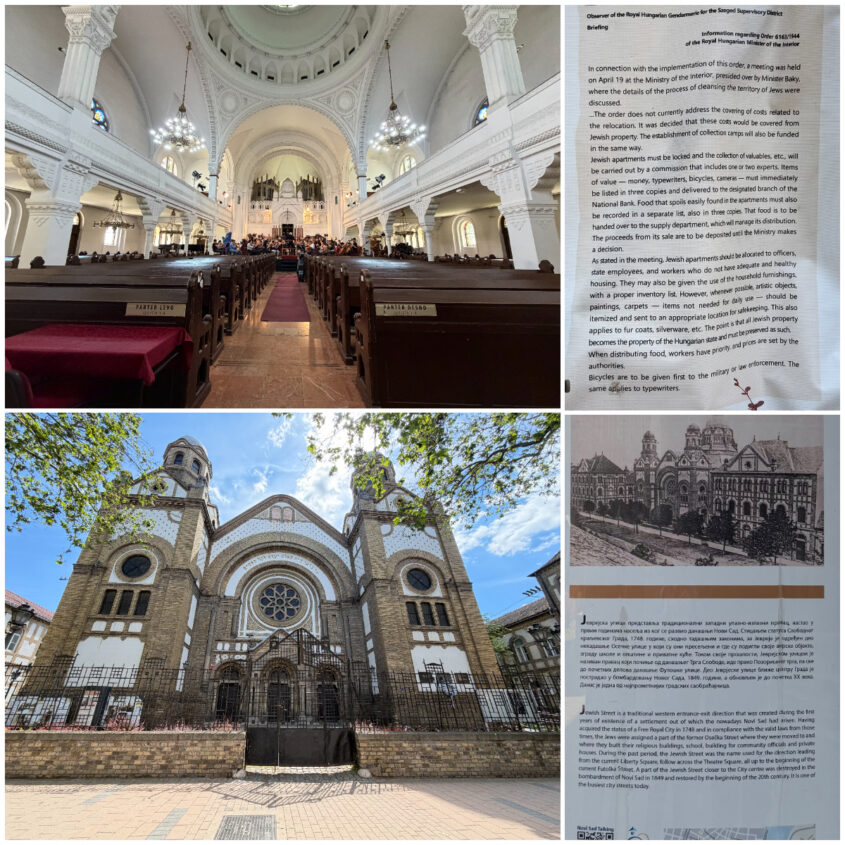
We visit the Novy Sad synagogue designed by the famous Hungarian architect Lipot Baumhorn, whose exceptional work we will see in several locations. The Reform movement in Hungary was called Neolog, (primarily among urban and more assimilationist communities) and Baumhorn’s synagogues are designed in this rite. On the site (no longer a place of worship but a national monument used as a cultural center) we observe a youth orchestra in rehearsal, which was both sad and oddly moving. The site used to hold several buildings – community center, school, mikvah, but there is no longer a Jewish community large enough to support it. The pre-war community was itself small, (4,000) but economically and commercially very important. (ie – they had a target on their backs.) A series of photographs on display in the courtyard shows some of the stomach-churning descriptions of the round-ups of Jews – who were held in their own beautiful Shul waiting for trains to nowhere – their possessions (shoes, suitcases) left behind to be picked over – the soaring space eventually used as a stable or a gymnasium. (See the announcement below top right: ‘we can’t afford to round you up and “deport” you, so you’ll reimburse us by giving us all your property, especially your homes and they will be redistributed to the people who have so helpfully “deported” you.’ ) No matter how much you know, it’s still mind-boggling.
On to Subotica which had a significant Hungarian population and some beautiful art deco buildings from its Hapsburgian days. The famous Lipot Baumhorn synagogue was unfortunately closed on the day of our visit, and since it is run by the city and not the community – good luck getting around that. Our guide, Davor, sneaks us into the garden where we can wander the perimeter and admire the beautiful reconstruction.
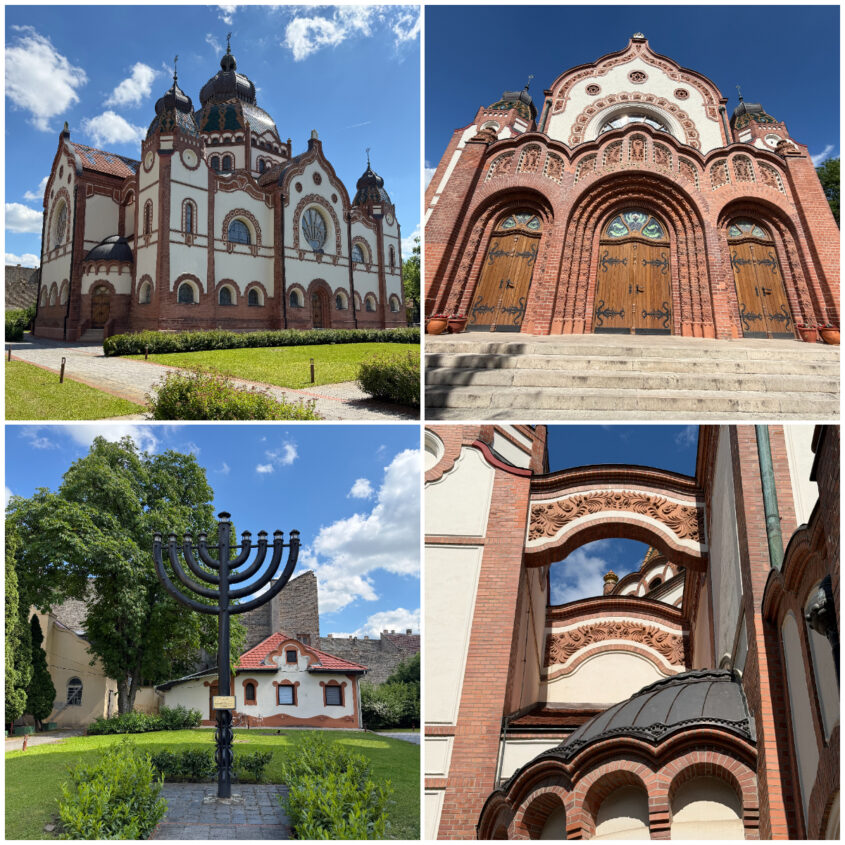
We dodge the touchy issue of not eating in the small restaurant that allowed us in through their back door, then take a stroll through the delightful town. Many buildings in the art deco style, including fountains, city hall, art galleries, museums.
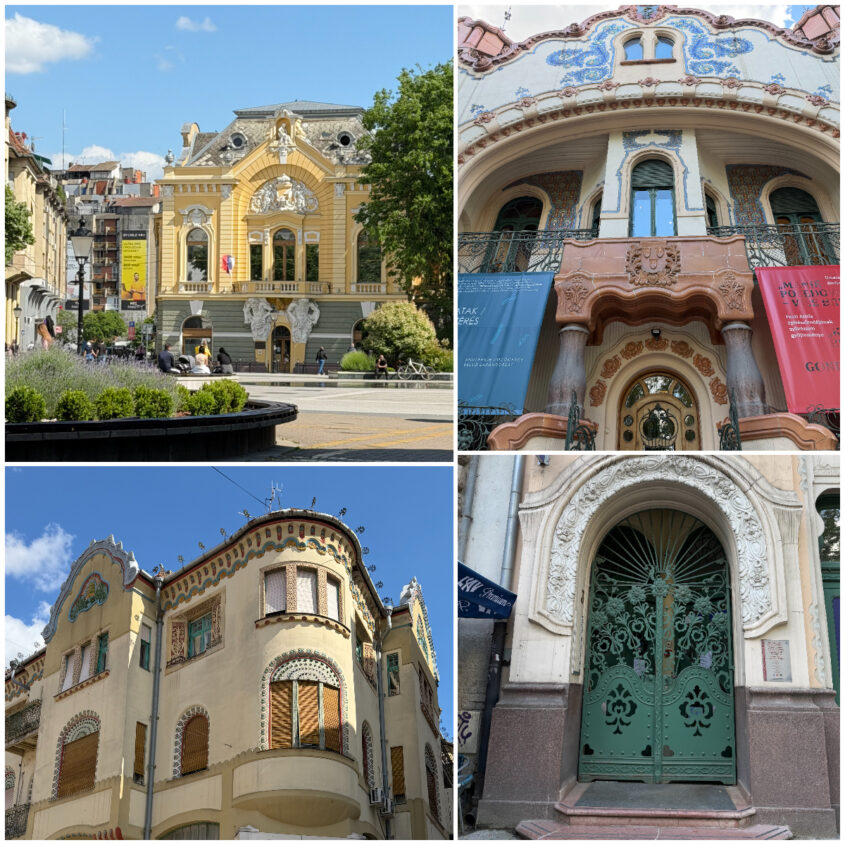
But we can’t leave without checking out the street still named in honor of Marshall Tito (in Serbian, Croatian and Hungarian)

By now it’s late afternoon and, although we are only a few miles from the Hungarian (and EU) border, we opt for the smaller of two border crossings which closes at 19:00. (7:00 PM). No problem, you think. On the way we stop at a gas station for the WC; no key necessary and maybe the cleanest public toilets I’ve ever seen. It occurs to me that all the facilities we’ve used in Serbia have been sparkling clean and brand new. (For the hundredth time while traveling I wonder what the hell is wrong with the US). But on to the border. And already it doesn’t look good. Long lines of traffic – at least 40 cars in front of us and maybe 15 cars are getting through in an hour. There’s barbed wire aplenty in the surrounding fields because we know that Hungary under Orban doesn’t like immigrants.
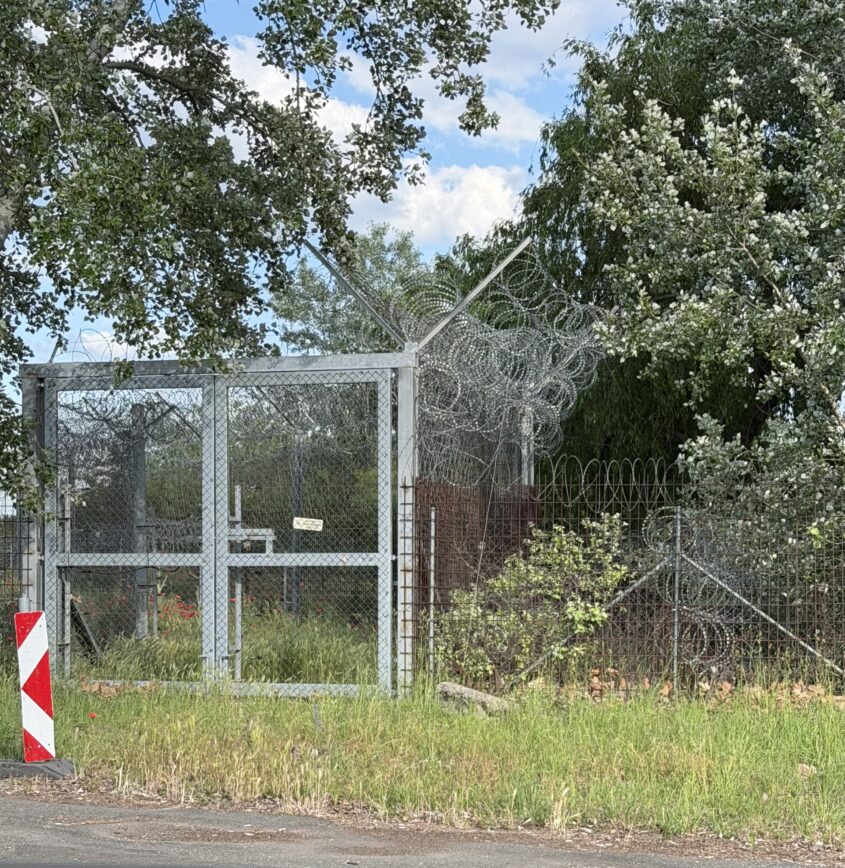
Finally, it’s our turn – and even though we have entered the EU dozens of times, you still have to be fingerprinted and photographed. Isn’t the unique iris print good enough? But no – our fingerprints are just not showing up and no amount of windex or hand-wiping will make it happen. We are holding up desperate (I imagine) cars behind us as the clock ticks towards 19:00. Finally the guards (there are three of them with a total age of maybe 65) give up and wave us through. And we’re back in the EU.