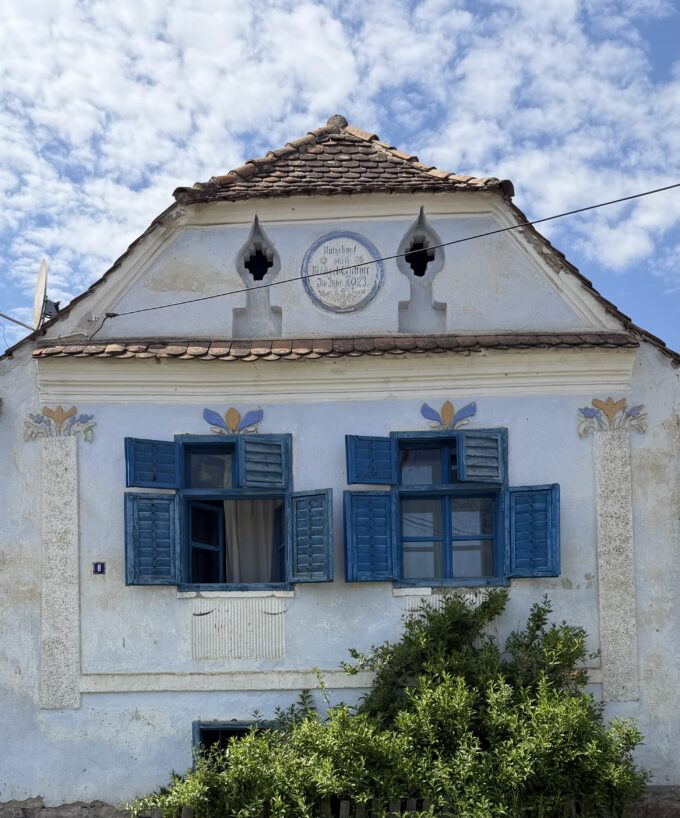
My late godmother was born in Transylvania in 1910 – when it was still part of Hungary within the Austro-Hungarian Empire. Her accent was exactly what you’d associate with Zsa Zsa Gabor: Every sentence ended with a drawn-out “dahlink.” I hear it still. Oh, the images that Transylvania conjures! Castles and misty mountains and the sound of wolves (unrelated to those in Yellowstone.) The power of myth! Transylvania was both Hungarian and Saxon German – who were invited as far back as the 12th century by the Hungarian Kings to protect their southern flanks against (who else?) the Ottomans. Arriving from Luxemburg and the Rhineland in the Middle Ages, the Saxon Germans created a highly prosperous and virtually autonomous region around seven fortified German-speaking citadel cities with names like Klausenburg (present day Cluj-Napoca) Schaumburg (Sighisoara) and Kronstadt (Brasov) — all of which we will visit.
The area was ceded to Romania after WWI and the Hungarian population hasn’t gotten over it. The Saxon population is another story – more later. As always in this part of the world, blood, soil, religion, ethnicity, who was more important in holding off the Ottomans – still matters. But let’s get started.
Our guide Andrei arrives to collect us in Szeged and we’re off. First we breeze through the Hungarian-Romanian border, and on to Timisoara, “capital” of Western Romania with a population of 400,000. I expect to see a much poorer country than either Bulgaria or Serbia – but not so. The usual outer ring of Soviet-style construction seems less awful (mostly 1980s) and roads are surprisingly excellent. There appears to be significant new housing stock – and even though buildings are outwardly shabby, we are assured that inside apartments are individually owned and completely renovated. Unfortunately, no one feels obligated to pay for the “communal” outside upkeep and maintenance of the building itself. (No concept of condo fees evidently, and the idea of common upkeep for a greater good has been totally shattered). Most people purchased their apartments from the government in the 1990s after the 1989 downfall of the hated Ceausescu and his North Korean style dictatorship of deprivation (and degradation). The homeless population is almost non-existent.
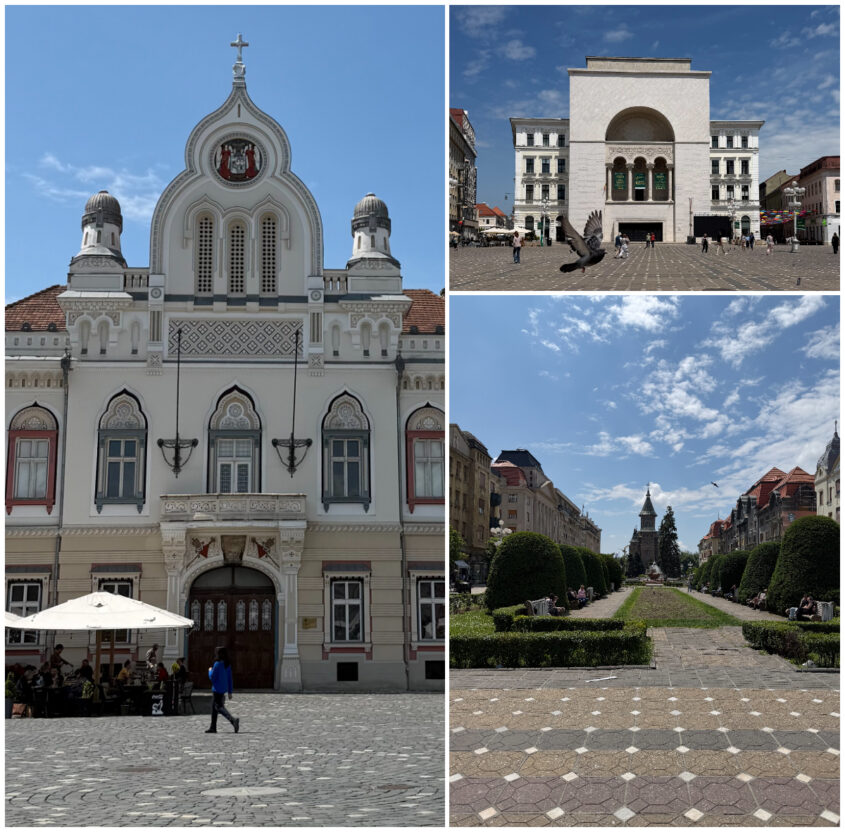
Timisoara L to R: Hapsburgian city center. National Opera. Victory Square where the unravelling of the Ceausescu regime began.
During a meander through the town, we pass the Cetate Synagogue (Fortress Synagogue), one of three in the city – but the only one being restored to its original state (from 1860). It’s closed, but fortuitously Andrei catches one of the designers leaving on a lunch break and persuades her to let us in for a quick look. What luck! And what a labor of love – it is more likely to be used as a cultural center (there are no Torahs in the ark, but it’s clear that the artists involved (none of them Jewish) have taken this on as a personal project of great pride.
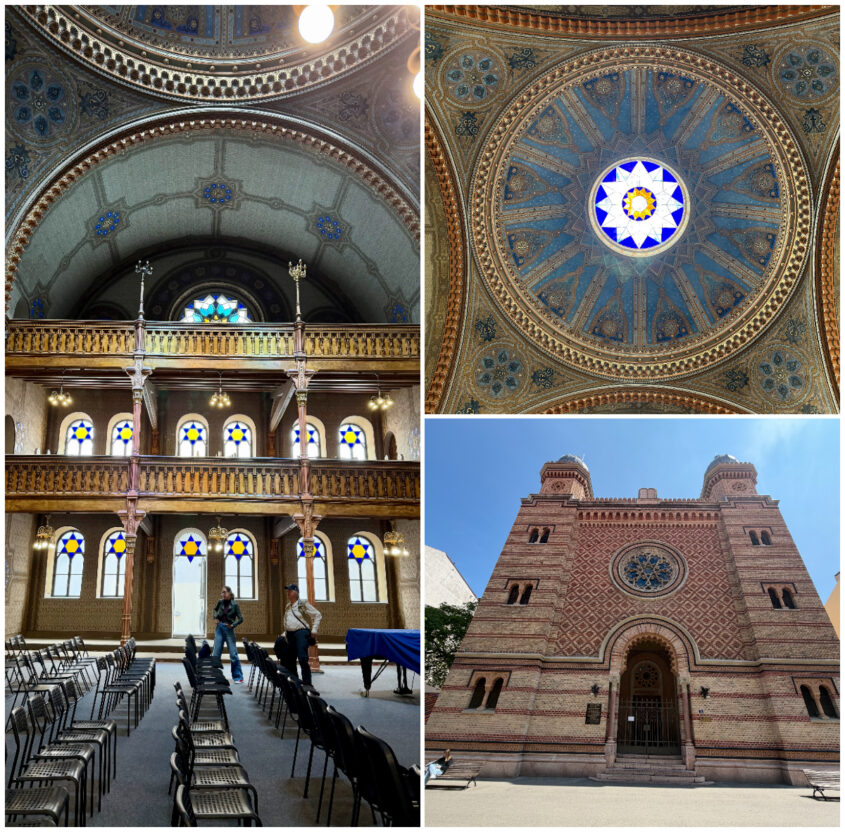
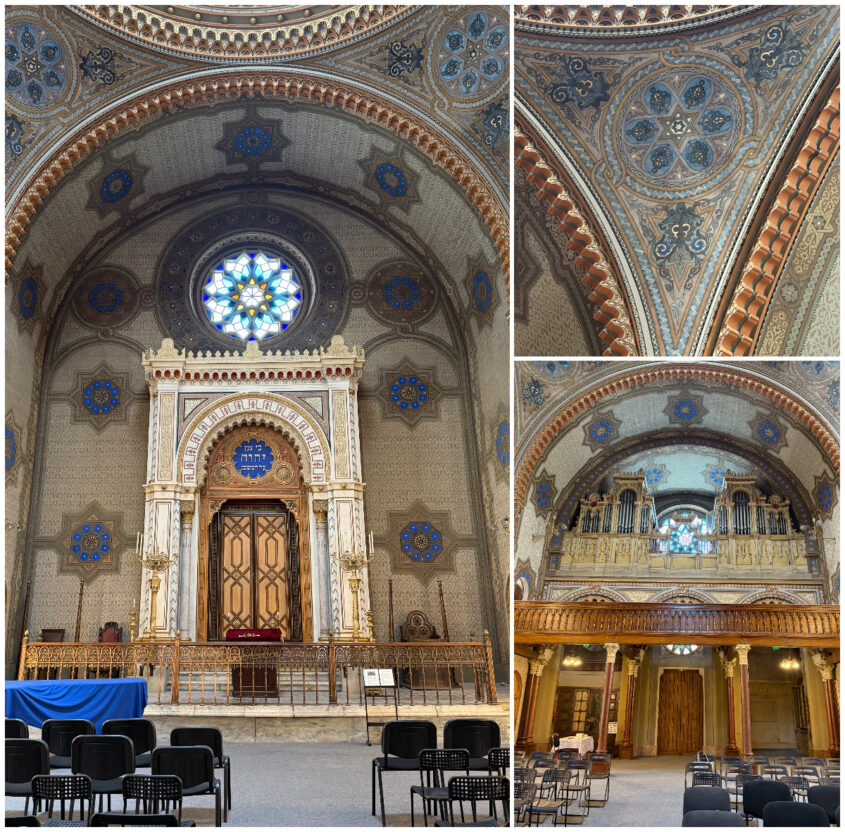
Inside the Fortress Synagogue (Cetate or Citadel). Working from old photos and whatever paint remnants and motifs they could find, the artisans have done an amazing recreation. No longer a sanctified space, it is used for concerts.
We are just passing through, but Timisoara is worth a longer stopover – another pedestrianized city center with parks, terrace cafes, Art Nouveau buildings, people hanging out, large city squares with a heaping spoonful of Vienna. Pleasant, a touch shabby, the usual graffiti, but an invitation to linger. Instead we head off to Cluj-Napoca – a very long, drive with a lengthy blockage for road works on a winding hilly pass – and first impressions aren’t great: Cluj is the country’s second largest city with a large student population, more traffic, and it doesn’t help that we arrive in the rain. But that’s why you have to get over first impressions and take time to explore.
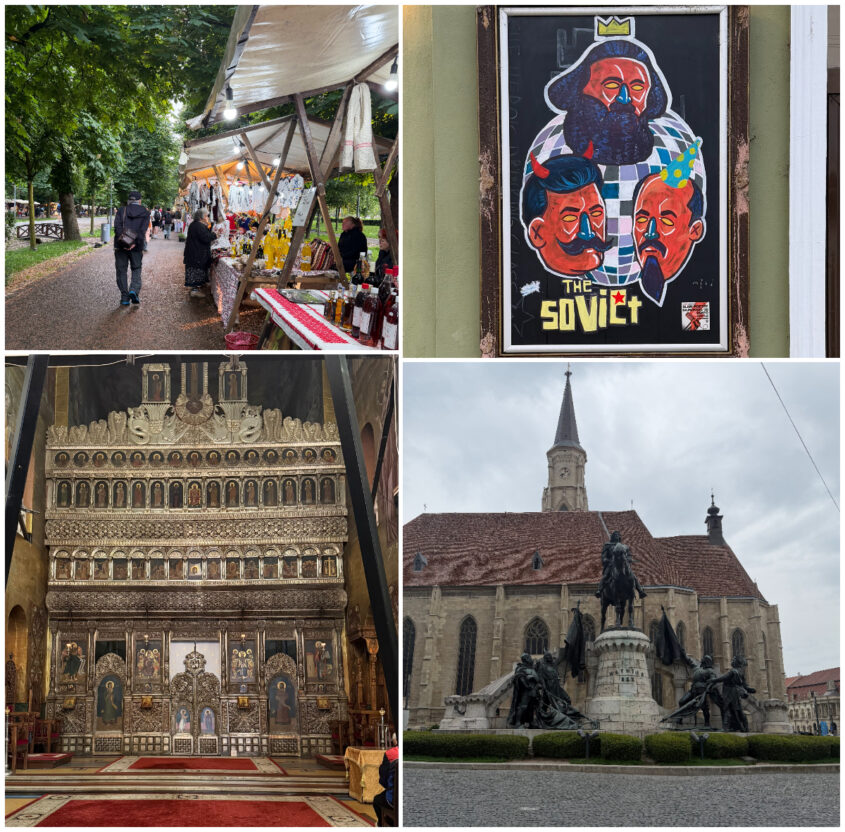
Summer festival in the park, kitschy Soviet pub, iconostasis in a church into which we hung out during a downpour (love these tiny jewel box churches), and the grand St. Michael’s church that announces the city center.
In fact, it turns out to be a lovely city with an old city center, many churches, leafy extensive parks, statuary, a long riverwalk bordered with restaurants, pedestrian walkways, cafes, and a huge festival being set up with sound stages and booths. We visit the much finished and many times restored synagogue – the community reduced from a prewar population of 18,000 to a current aged handful – and another history lesson of horror. This synagogue is actually called the Temple to the Deported, and the reconstruction, while clean and bright, shows no trace of its original design.
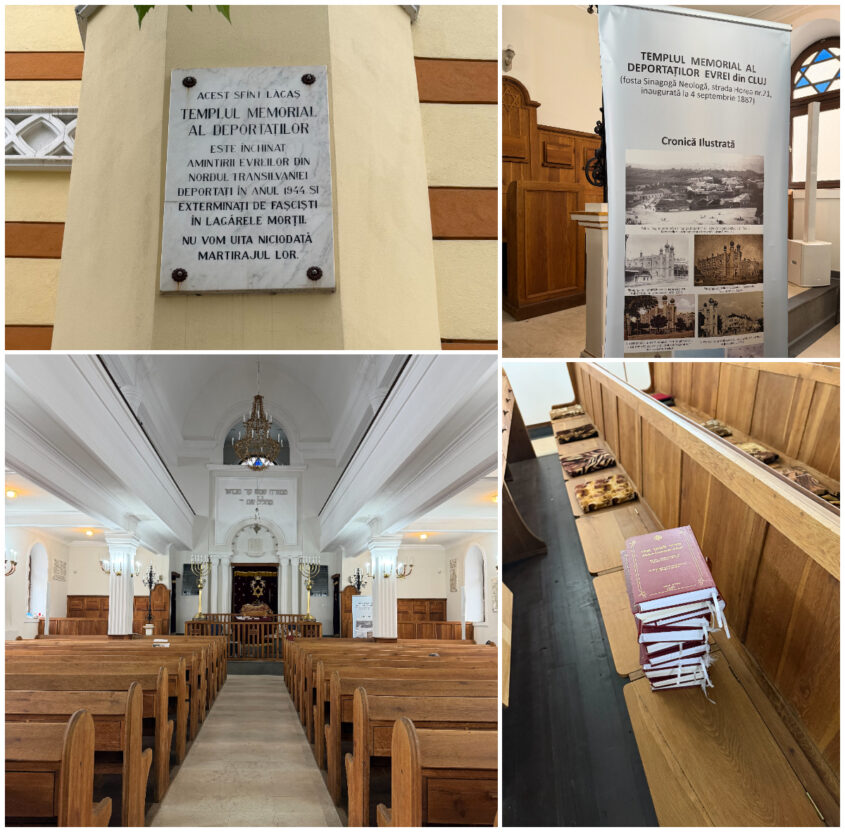
I am touched by the sight of perhaps 10 cushions and a stack of prayerbooks for the few remaining (elderly) attendees.
Nearby, there is a small but impressive museum that explores Jewish life in Cluj in the early 20th century with an option to follow the experiences of three members of the community through the war and its aftermath (all three survived). One was rescued on the controversial Kastner train (worth a chapter – check the links at the end of the Balkans 2 section). Prior to WWII, Romania had the third largest Jewish population (757,000) in Europe. The Jews of Bessarabia and Bukovina (bordering Ukraine and Moldova) and in Transnistria were decimated both by the Nazis and the Romanian Iron Guard butchers (no other word for it). In the southern regions around Bucharest, Jews fared somewhat better with half the population (about 375,000) surviving the war only to face repression under Communism. Over 100,00 emigrated immediately to Mandatory Palestine, and limited emigration to Israel followed for decades. Romania used its diplomatic ties with Israel to strike a deal to pay for the continued exodus in economic aid and hard currency. The remainder of the Jewish population left after the fall of Communism and today is less than eight thousand and mostly in Bucharest. Shadows everywhere.
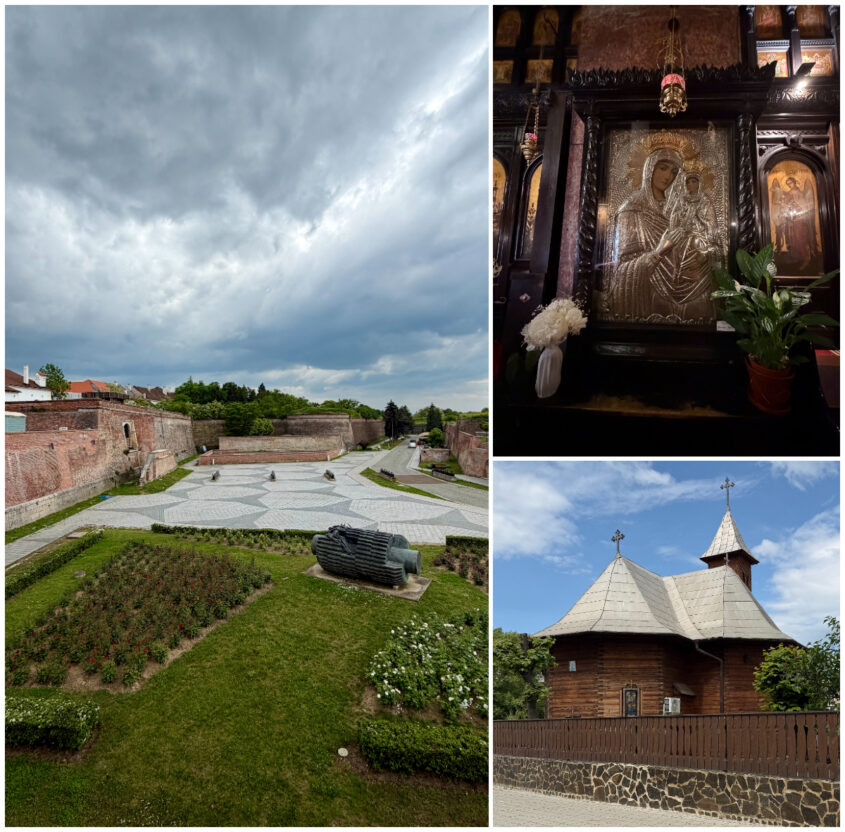
We do a side trip to Alba Julia – a fortress city with some of the oldest Roman ruins in the country; a reconstructed palace with stories of fending off the Turks; (empires and their battles are never off the table) and a pleasant Romanian Orthodox Church. It’s high school graduation time and young ladies are dressed to the nines, hanging out in groups.
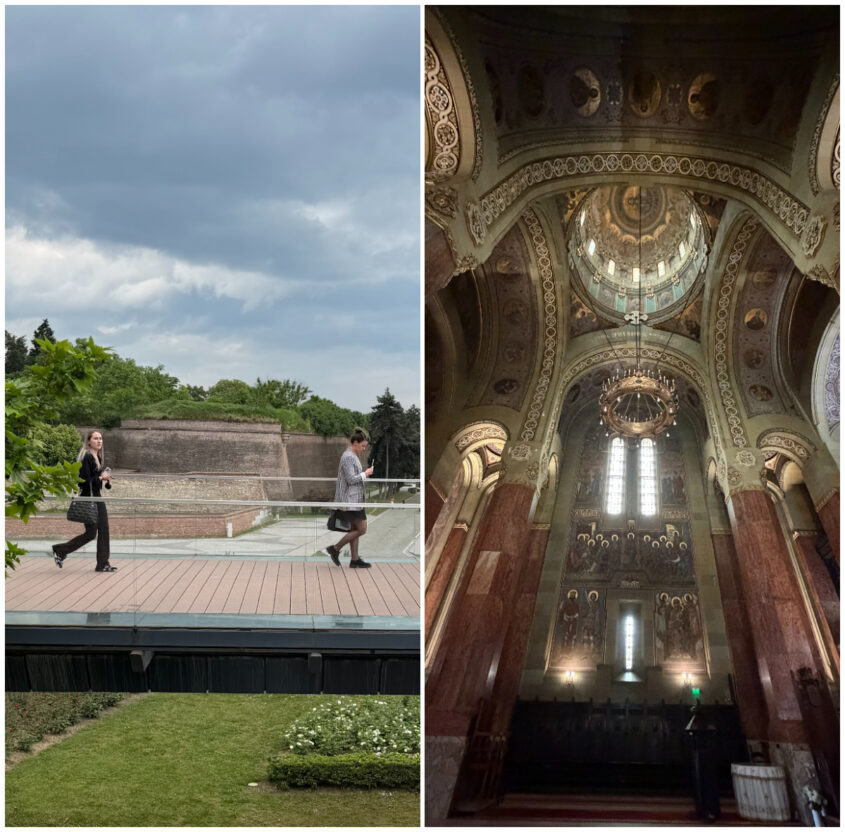
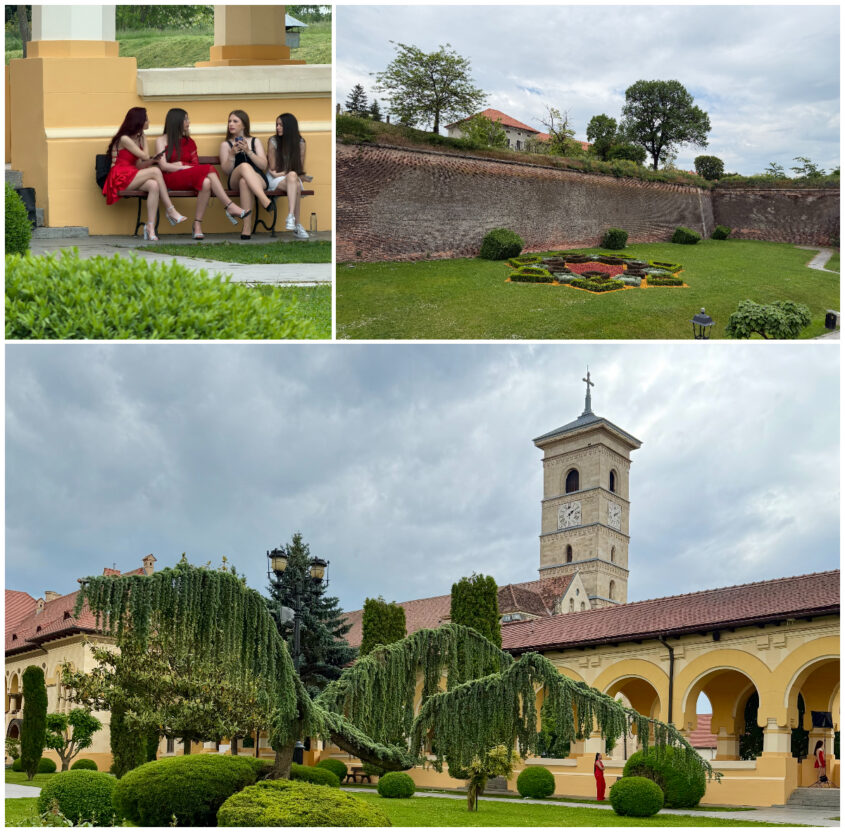
Above and below: scenes from Alba Julia; remnants of Roman walls turned into a fortress, the grounds and inside of a Romanian Orthodox church, young ladies in their finest (and super high heeled shoes) during high school prom photos, and a wooden church out of place -hey are usually found only in the north.
We head back to Cluj, lots of walking through a summer festival, dinner (goulash!) at a local restaurant, a quick trip to the art museum for me, and a happenstance meeting in the tiny hotel elevator with a former neighbor from the Boston suburbs. (What are the odds?)
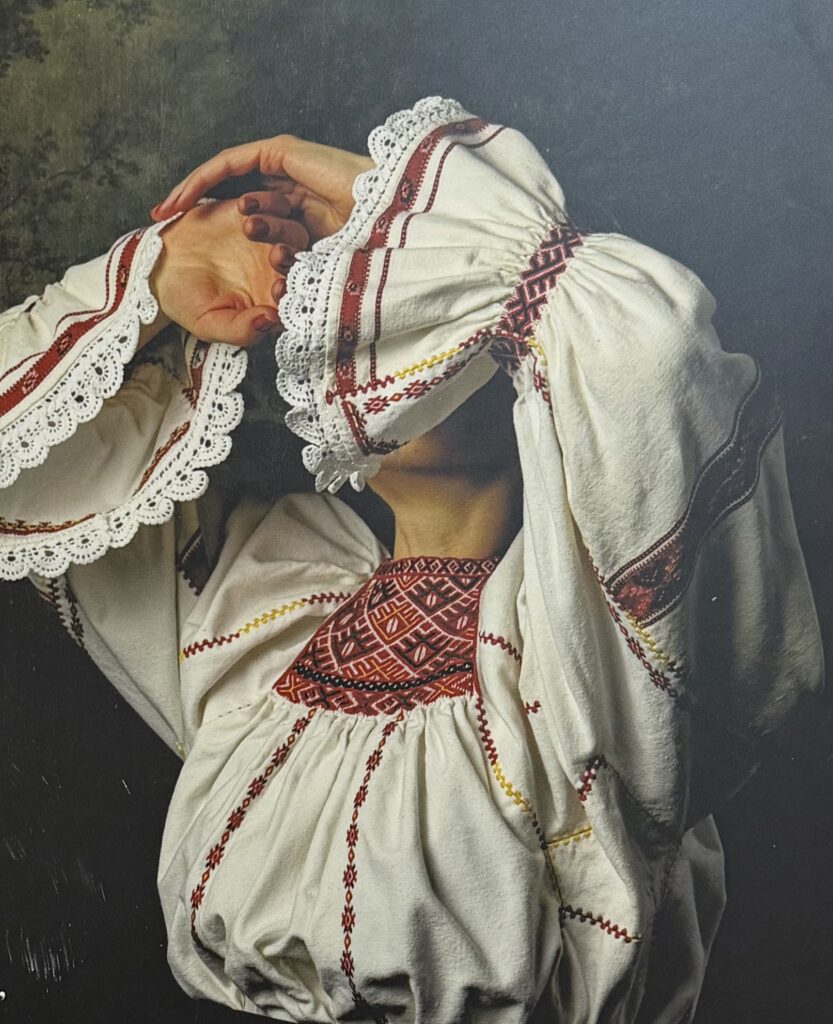
Poster advertising an exhibit in the Cluj Art Museum